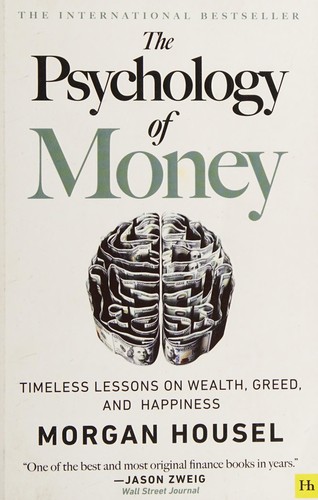
What the Book Is Actually About
Twenty short, almost essay-style chapters arguing one thing from twenty angles: doing well with money has surprisingly little to do with how smart you are, and almost everything to do with how you behave. Housel is a partner at Collaborative Fund and spent a decade writing for The Motley Fool; the prose is conversational, the examples are stories, and the maths is light. The book is not a how-to. There are no asset-allocation tables, no budget templates, no formulas. It's an argument that the optimisation-heavy default mode of money advice — pick the right index fund, run the right spreadsheet — misses the only variable that actually moves the needle: your own behaviour over thirty or forty years.
The opening line gives the thesis cleanly: "Doing well with money has little to do with how smart you are and a lot to do with how you behave. And behaviour is hard to teach, even to really smart people." Everything that follows is Housel chipping away at that, with stories of janitors who died wealthy, Harvard MBAs who went bankrupt, and the boring people in between who quietly did fine.
The Five Ideas That Stuck
There are twenty chapters and at least a dozen good ones, but if I had to pick the five that have actually changed how I think about money — these are them. Each idea is summarised, then the one practical thing it changed for me.
1. No One's Crazy
Your beliefs about money are not derived from first principles. They are built out of experiences you didn't choose to have — your country, your decade, your parents' relationship with debt. A boomer who watched 18% mortgage rates and 14% inflation in the early 80s and a millennial who lived through fifteen years of near-zero rates are responding rationally to entirely different data sets. Both think the other is crazy. Both are doing the right thing for the world they grew up in.
Housel cites a paper showing that the single biggest predictor of someone's lifetime investment behaviour is the stock market's performance during their young adulthood. Not their education, not their income, not their IQ. The market they happened to live through at twenty-five.
2. Tails Drive Everything
Heinz Berggruen made his fortune as an art dealer not because his average pick was good but because a handful of works he held became Picassos and Matisses. Same with venture capital, same with the stock indices. Hendrik Bessembinder studied every US stock from 1926 to 2016 and found that just 4% of listed companies produced all of the market's net gain above Treasury bills. The other 96% collectively returned nothing.
If you can't pick the 4% in advance — and you can't — your job is to stay in the game long enough to be holding the index when the tails arrive. Most ruin comes from getting forced out at the wrong time: a margin call, a panic sale, a tactical pivot at the bottom.
3. Wealth Is What You Don't See
The cleanest single sentence in the book: "Wealth is the nice cars not purchased. The diamonds not bought. The watches not worn, the clothes forgone, and the first-class upgrade declined." Income is what comes in. Spending is what goes out. Wealth is the gap — and the gap is invisible, by definition. The Lamborghini next to you at the lights tells you about the driver's spending, not their balance sheet. The actually-wealthy people you know are mostly indistinguishable from the broke ones at a glance.
Which means we model our spending on the wrong reference class. We see the consumed-wealth (the cars, the bags, the holidays) and assume that's what wealth looks like. The unconsumed-wealth — the index funds, the cash, the freedom — is by construction invisible. So we calibrate our own lifestyle against a peer group whose actual finances we cannot see.
4. Reasonable Beats Rational
On paper, you should have 100% equities for the long run. In practice, you should have a portfolio that lets you sleep through a 50% drawdown without selling. The optimal portfolio is the one you'll actually stick with. Paying off a low-interest mortgage early is mathematically suboptimal and emotionally invaluable. Holding a chunk of cash that "should" be invested is mathematically suboptimal and might be the only thing standing between you and panic-selling at the bottom.
Housel's framing: don't aim to be coldly rational. Aim to be reasonable — a strategy that you, the messy human, will follow for three decades without abandoning. The compounding from sticking with a 7%-return strategy for 30 years dwarfs the difference from a 9%-return strategy you bail on in year 4.
5. Room for Error
The future has two surprises in store for you: the world will turn out different from your forecast, and you will turn out different from your forecast. The forty-year-old you cannot reliably predict what the fifty-year-old you will want. Career change, family change, health change — the long-term plans we make are made by a person who will not exist by the time the plan matures.
The response isn't to plan harder. It's to leave more margin than the model suggests — bigger emergency fund, lower fixed costs, smaller projections, decisions that survive being wrong. Housel calls this "room for error" and treats it as the most underrated financial skill there is. Margin doesn't show up in the spreadsheet because the spreadsheet assumes the spreadsheet is right.
Five Quotes Worth Pinning
"Spending money to show people how much money you have is the fastest way to have less money."
"The hardest financial skill is getting the goalpost to stop moving."
"Save. Just save. You don't need a specific reason to save."
"Doing well with money has little to do with how smart you are and a lot to do with how you behave."
"Controlling your time is the highest dividend money pays."
Who Should Read It (and Who Shouldn't)
Read it if you are:
- In your twenties or thirties, building the habits you'll compound for forty years.
- An engineer, analyst, quant or any other optimiser type whose default mode is "find the right number" — the book is the antidote you didn't ask for.
- Recovering from a tactics-heavy money diet (rich-dad-poor-dad, finance Twitter, daytrading content).
- Anyone who already knows personal finance and keeps doing the wrong thing anyway. This is the layer underneath the tactics.
Skip it if you are:
- An active trader looking for a tactical edge — Housel is explicitly arguing against tactical edges.
- Looking for "do X, then Y, then Z" prescriptive advice. The book deliberately doesn't tell you what to invest in.
- Already deeply read in the genre (Bogle, Bernstein, Collins) — you'll nod along but won't find much new.
What I Actually Did Differently
Books that don't change behaviour are entertainment. Here are the four concrete things that changed in my own money life after reading The Psychology of Money — not all from this book alone, but accelerated by it.
- Defined "enough" with a number. Net worth, monthly spend, annual income — three numbers, written down, re-read each January. The single best protection I've found against goalpost drift.
- Stopped optimising my asset allocation to the decimal. Picked a boring, broad, automatic strategy I will hold for thirty years. The behavioural compound from never touching it outweighs every "smart" tweak I would have made.
- Ignored visible peer benchmarks. The colleagues whose lifestyle looked richer were almost always running thinner balance sheets than me. Once that clicked, the social pressure dropped a lot.
- Held an embarrassingly large emergency buffer. The conventional advice is 3–6 months. I keep more. The optionality has paid for itself twice already — once for a career bet, once for a family bet. Both decisions would have been worse without the cash on hand.
The Verdict
Three reads in, this is the only money book I recommend without hesitation, to almost any audience. It will not make you rich next quarter. It contains no edge, no tactic, no "weird trick." What it does, slowly and quietly, is make you the kind of person who is unlikely to do something catastrophic with money — which, statistically, over a long enough timeframe, is the same thing as becoming wealthy.
The half-star I dock is for repetition. Housel makes essentially five points twenty different ways, and by chapter sixteen you've heard them. But that's also the design: most behavioural change comes from hearing the same true thing said in five different angles until one of them sticks. So the repetition is probably load-bearing, not lazy. Read it. Then read it again in a year, when the version of you who first read it has been replaced by someone slightly different.