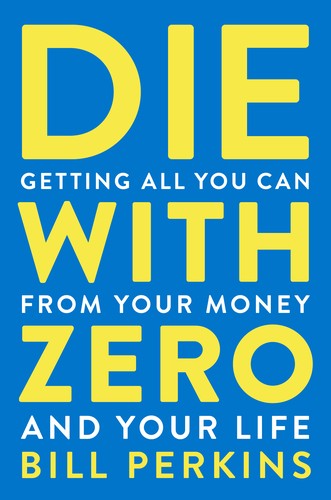
What the Book Is Actually About
Nine short chapters, one heretical thesis: the goal of a financially examined life is not to die with the largest pile, but to convert money back into experiences and impact at the rate that maximises lifetime fulfilment — and ideally, to finish with close to zero. Bill Perkins is an energy-trader and hedge-fund founder turned amateur philosopher; the book reads less like a memoir and more like a calculus problem he's been chewing on for twenty years.
The core question Perkins keeps returning to is this: your job is to maximise total life enjoyment, not total life savings. Saving is a tax you pay so future-you can spend. But future-you has worse knees, less curiosity, smaller social circles, and a steeper diminishing return on dollars. So the dominant strategy of "save aggressively, spend conservatively, leave the rest to the kids when you're 90" is — Perkins argues — almost certainly mis-allocating tens or hundreds of thousands of dollars of fulfilment. The book is the case for re-allocating it.
The Five Ideas That Stuck
There are nine rules in the book and the framework is genuinely interlocking — pulling one out weakens the others. But these five are the ones that have actually changed how I think about the next ten years.
1. The Net Fulfilment Curve
Imagine plotting your lifetime fulfilment on the y-axis and net worth on the x-axis. The shape isn't linear. There's a peak — the point at which an extra pound of savings buys you essentially no additional life satisfaction, while costing you one more pound of experience-converting power right now. Perkins argues most people unknowingly aim for the asymptote: they accumulate well past the peak, then die before they spend it down.
The corollary is uncomfortable: if you're saving heavily in your 50s and 60s, you may not be being prudent; you may be over-shooting. The ideal trajectory looks like a hill that peaks somewhere in your 40s–60s (your "die-with-zero date" depends on your risk tolerance, dependants, and longevity outlook) and then deliberately declines.
2. Time-Bucket Your Life by Decade
A bucket list is useless because it ignores timing. Trekking Patagonia at 32 and trekking Patagonia at 72 are not the same experience. Your knees, your stamina, your visual sharpness, your social cohort — all decline along their own curves. Perkins suggests dividing your remaining life into decade-buckets and assigning every aspirational experience to the bucket in which you'll most enjoy it.
That move alone forces a hard conversation: the year you waited to do a thing because "we'll get to it" was a year subtracted from a finite, time-stamped bucket. Some experiences (high-energy travel, having young kids, learning physical skills) belong almost entirely in your 20s–40s bucket. Others (museums, slow travel, lifelong learning, mentoring) survive long into the later buckets. Knowing which is which changes when you do them.
3. Memory Dividends — Experiences Compound
Perkins' single best insight. When you spend money on a thing, you get the thing once. When you spend money on an experience, you get the experience once and the memory of the experience for the rest of your life — and that memory pays you compound interest every time you recall it, every time it shapes a future decision, every time you re-tell the story. He calls this the memory dividend.
The implication is sharp: experiences purchased at age 25 have 60+ years to compound. Experiences purchased at 80 have a few. The earlier in life you buy an experience, the bigger the dividend stream — which inverts the usual logic that you should "wait until you can afford it." The longer you wait, the less the memory has time to pay you back.
4. Give While You're Alive
Inheritances are mis-timed gifts. The average age someone receives a meaningful inheritance is around 60 — which is, on Perkins' framework, precisely the age at which an extra pound of money produces the smallest additional fulfilment. Meanwhile, your kids could have used that same money at 28 to clear student debt, buy a house, or take a career risk — when the marginal utility was 5× to 10× higher.
Same argument applies to parents, to charity, to anyone you intend to give to. The optimal time to give is when the recipient has the most use for it, not when you have the least use for it. Those two moments rarely coincide. Plan accordingly, and start moving money earlier than feels natural.
5. Health Is the Real Currency
The book's most uncomfortable chapter argues that every pound spent on protecting your health is leveraged spending on every other category — because health is the multiplier on every experience you can have. A weekend in Lisbon at 45 with bad knees and 6/10 energy is a different weekend than the same weekend with strong knees and 9/10 energy. You can't buy the second one back at 65.
Perkins frames it as the highest-ROI allocation a human can make: time and money on cardiovascular fitness, strength, sleep, and resistance training in your 30s and 40s buys you a longer high-quality bucket in your 60s and 70s. The years extended at the back end aren't lying-in-bed years. They're keep-doing-what-you-love years.
Five Quotes Worth Pinning
"You should be focusing on maximising your life enjoyment, not your wealth."
"The sad truth is that too many people delay gratification for too long, or indefinitely. They put off what they want to do until they no longer can."
"Memories pay dividends. The earlier you buy an experience, the longer the dividend stream."
"If you give to your heirs at the time of your death, you are essentially giving them money when it's of least use to them."
"Health is so much more valuable than money — every increase in health improves enjoyment from every future activity."
Who Should Read It (and Who Shouldn't)
Read it if you are:
- In your 35–60 window — this is where the framework has the most leverage. Earlier than 35 and you don't yet have the capital to deploy meaningfully; later than 65 and most of the time-buckets have closed.
- A natural saver, optimiser, or "responsible" type whose default mode is delayed gratification. The book is exactly the corrective you weren't going to give yourself.
- Currently planning an inheritance, a sabbatical, a big experience-spend, or a career pivot — anything that's a deploy-the-pile decision rather than an accumulate-the-pile decision.
- Living in the kind of slow-creep where "we'll do that one day" has become an unstated five-year plan.
Skip it if you are:
- Not yet financially stable. The framework assumes you've already mostly solved the accumulation problem — the book is silent on how to fix the cash-flow problem if you haven't.
- Risk-averse about longevity. Perkins is bullish on annuities and on "die-by-X" planning that some readers find genuinely uncomfortable. If actuarial-style thinking about your own death repels you, this isn't going to land.
- Looking for warmth. The prose is utilitarian and the framework can feel cold — fulfilment as a calculus problem is a slightly chilly framing. Pair with something more humanist if needed.
What I Actually Did Differently
Like the previous review in this section, the test of the book isn't whether I nodded along. It's what I did afterwards. Five concrete changes — not all from this book alone, but accelerated by it.
- Built the decade table. One page, on paper, decades 30s–80s across the top, experiences down the side, ticks for which experiences belong to which decade. The visual was shocking. It re-prioritised three things I'd been deferring.
- Front-loaded a big experience. A trip we'd been saying "next year" to for four years went in the calendar with a deposit in the same month I finished the book. The deposit was the part that mattered — paid future-me's resistance off in advance.
- Started a gifting-while-alive line. A modest, recurring transfer to a family member who could use it now rather than in thirty years. Small enough to be sustainable, large enough to actually shift their decision space.
- Reclassified health spend as investment. Personal training, decent shoes, sleep equipment. Same money, different mental category. It stopped feeling like indulgence.
- Wrote down a tentative "die-with-zero" target age. Not because I plan to die on schedule, but because the act of writing it down forces explicit planning for the decline of the net-worth hill, which I'd been implicitly avoiding.
The Verdict
The framework is a 10/10; the book is an 8. Perkins is a better thinker than he is a writer — the prose is sometimes flat, the examples lean too heavily on his hedge-fund peer group, and the chapters could probably be 30% shorter without losing anything. None of that matters. The mental model — that fulfilment is a flow that has to be optimised, not a stock you maximise — is genuinely original in a genre that mostly recycles Bogle.
Read it as a companion to The Psychology of Money: Housel will keep you from blowing it up, Perkins will keep you from quietly under-living. Together they cover both sides of the only money question that really matters — how much, and for what? Read this one in a single sitting, then go look at your calendar and your bank account. You'll start moving things around.